COIROLOGY JOURNAL · Seasonal growing
Autumn greenhouse watering in coco coir
As autumn light and temperatures change, revisit irrigation decisions rather than carrying summer timings into a different growing environment.
Start with conditions, not the calendar
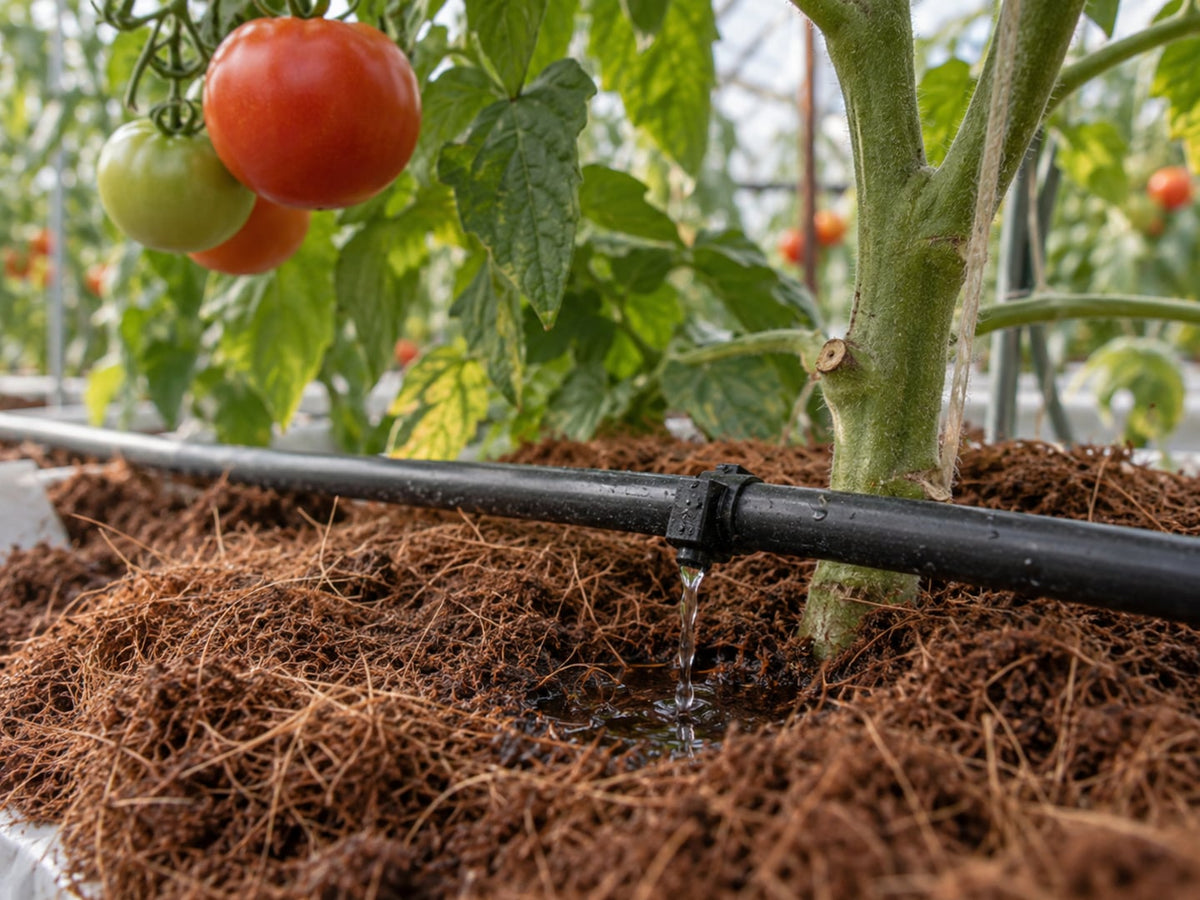
October is a prompt to review the greenhouse, not a universal instruction to cut every irrigation event by the same amount. Crop size, heating, ventilation, container volume and the substrate all affect water use. A productive heated crop and a young plant in an unheated greenhouse need different decisions.
RHS autumn guidance recommends making use of suitable ventilation conditions and watering early enough for surfaces to dry before evening. Adapt this to the crop and production system rather than treating it as a fixed commercial irrigation recipe.
Check more than the surface
A dry-looking surface does not necessarily describe moisture throughout a pot. Check representative containers and compare their condition before and after watering. Where practical, lifting pots can provide a useful comparison of water status; use consistent observations rather than an isolated impression.
For monitored systems, examine trends as well as the latest reading. Sensor position, contact and suitability for the growing medium matter. A sensor is a measurement at a location, not proof that every part of the crop has the same conditions.
Review irrigation in small, recorded steps
Write down the current irrigation pattern and what you want to improve. Review the timing and amount alongside root-zone moisture, drainage and crop observations. Change one part of the programme at a time where possible, then compare the response under similar weather.
Avoid publishing or adopting a universal water-content target for all coir. Different particle structures and containers behave differently. Use an agreed crop-specific approach with your adviser where the system requires precise control.
Connect watering with humidity management
UMass identifies watering practice, air movement, spacing and ventilation among the ways to manage greenhouse humidity. Irrigation decisions therefore belong alongside climate observations, rather than being considered in isolation.
Keep a brief daily record of condensation, persistent wet areas and uneven drying. Check blocked drains and leaks before assuming the substrate is at fault. Correcting a delivery or drainage problem can be more appropriate than changing the formulation.
Keep nutrition in the review
When fertigation supplies nutrients through irrigation, changing water delivery can also change nutrient delivery. Review this with the feed programme instead of compensating automatically with a stronger solution. EC reflects dissolved salts and needs a defined sampling method for meaningful comparison.
Read NPK and coir for feeding considerations and our coir pH guide for measurement context. The objective is a documented response to the crop, not a seasonal rule applied without checking.
Sources and further reading
PUT IT INTO PRACTICE
Discuss your growing requirements
Find the next step for your growing or supply requirements.
Discuss your growing requirements